
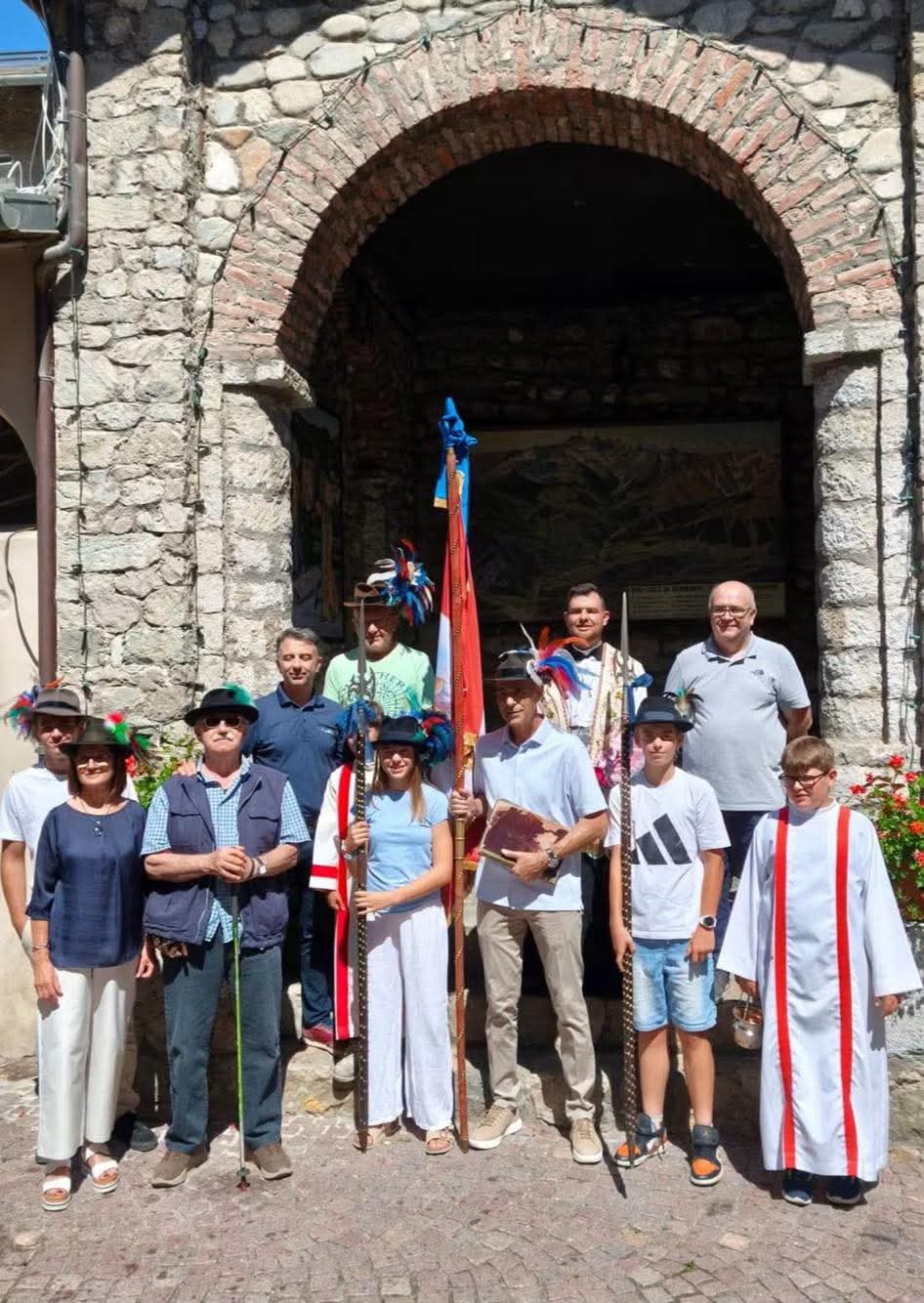
Each year, on the church forecourt, the Compagnia di Sant'Eligio renews the rite of the handover: the outgoing Abbà entrusts to his successor the halberds and the register of the Compagnia, and with them the duty of keeping, for a year, a tradition passed down in Vernante for centuries.
The text below accompanies the ceremony: it recounts its origins, explains what the emblems of the Abbà mean, and describes the gesture by which the tradition changes hands.
The Handover of the Baja of Vernante
Text by Loretta Macario
English translation of the Italian original. Terms belonging to the local tradition are left in the original language. Originale italiano .
Welcome to you all, citizens and guests of Vernante! We find ourselves today at the beating heart of our oldest festival, a moment in which the present bows respectfully to history.
To grasp fully the magic of what we are about to witness, we must step back in time. It all begins with the venerable Compagnia di Sant'Eligio, formally set down in a written convention on 5 April 1858, but rooted in a far more distant past. Founded to care for and restore the chapel dedicated to the Saint — patron of the Cartunè, the carters who traded in timber and other goods — this association is an unbreakable bond between the generations. To this day, to belong to the "Baja" under the protection of Sant'Eligio, one must be descended from a small circle of the village's historic families — the Macario, the Bertaina, the Risso — who for centuries handed down the old and arduous trade of the "Cartunè".
But what exactly is the Baja? It is a re-enactment of medieval origin whose roots reach back to around the year 970. Legend tells that, under the leadership of the Abbà themselves, the people of the Vernante valley rose up with courage against the fearsome Saracen incursions from Spain.
Today, the figures at the very centre of it, before your eyes, are the Abbà. There is no hierarchy among them: there is a single Priore, who holds office for one year, and at his side his loyal companions. You will know them at once by their proud emblems:
- The Halberd: a round wooden shaft topped with a forked and jagged iron point, adorned with a red ribbon hanging from above: the symbol of command.
- The Hat: a black hat trimmed with embroidered ribbons of many colours, crowned with a lively spray of artificial flowers and a brightly coloured plume.
- The Mules: which we no longer have today, but which were once the true travelling companions of the old carters. On feast days they were decked out with coloured ribbons and the traditional "ciuchinere", the bells that ring out festively at the animals' muzzle and neck (each family had its own, with a matching coloured "blanket" to dress the horse or mule)
And so we come to the most important and most solemn moment of the celebration. On the church forecourt, after Mass has been celebrated, the outgoing Abbà and the incoming Abbà stand face to face for the handover.
What passes into the hands of the new Priore is not merely a baton, but the history of Vernante itself. The old Abbà formally hands over to the new one the dressed halberds, symbol of the authority and leadership of the Compagnia, and the register of the Compagnia, which holds the names of all those who have held this office over the years. With this gesture, the tradition has officially been passed on.
Immediately after this handover, solemnity once gave way to sheer popular joy. From the little square known as "La Mandoulera" the traditional parade of the "ancient horsemen" would set off: a cheerful, colourful procession winding through the streets of the village, re-enacting that old "people's army" celebrating victory and freedom regained. Long live the Baja, long live the Compagnia di Sant'Eligio, and a good handover to all!
The text of the handover is by Loretta Macario, whom we thank. For more on the history of the Compagnia and the list of members, see the History page.